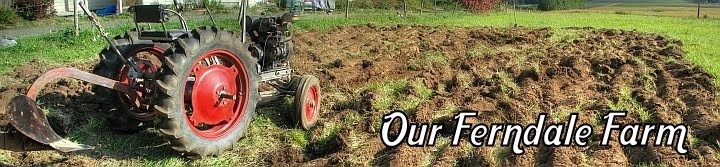
We had a work party at our new house this weekend and got so much work done. Most importantly (for this blog anyway), we got the garden rototilled. Went from hard-pan, scrubby grass and weeds, to 12" deep, finely textured soil.

The first pass was the worst; ripping out quack grass, reeds, and all kinds of weeds I can't even identify, was a process.

After 4 passes, with the last at the deepest tilling setting, I'm really happy with the soil tilth. I only found 3 or 4 rocks in the whole garden (!), and no clay deposits, so that is good. I can tell already that what is really lacking is organic materials. Some manure and compost would go a long way. I am planning on sending off a soil sample to my local extension office for a soil report, which will tell me the current chemical makeup of my soil, which will help me determine what I need to do this year to make the soil healthier for the future.
Before we bought the house I researched the soil composition from
this awesome government website. You can zone in on your exact piece of land (at least where I live) and get a full report on the soil in that area.
Here are the results for our 5 acres:
Whatcom County Area, Washington
179—Whatcom silt loam, 3 to 8 percent slopes
Map Unit Setting
- Elevation: 50 to 600 feet
- Mean annual precipitation: 35 to 50 inches
- Mean annual air temperature: 48 to 52 degrees F
- Frost-free period: 150 to 190 days
Map Unit Composition
- Whatcom and similar soils: 85 percent
- Minor components: 8 percent
Description of Whatcom
Setting
- Landform: Hillslopes
- Parent material: Volcanic ash and loess over glaciomarine deposits
Properties and qualities
- Slope: 3 to 8 percent
- Depth to restrictive feature: More than 80 inches
- Drainage class: Moderately well drained
- Capacity of the most limiting layer to transmit water (Ksat): Moderately low to moderately high (0.06 to 0.20 in/hr)
- Depth to water table: About 18 to 36 inches
- Frequency of flooding: None
- Frequency of ponding: None
- Calcium carbonate, maximum content: 5 percent
- Available water capacity: Very high (about 12.7 inches)
Interpretive groups
- Land capability classification (irrigated): 3w
- Land capability (nonirrigated): 3w
Typical profile
- 0 to 9 inches: Silt loam
- 9 to 16 inches: Silt loam
- 16 to 26 inches: Loam
- 26 to 60 inches: Loam"
And there's WAY more information than that. Very interesting and useful website.


 Kale, kohlrabi, two kinds of cabbage, and broccoli mix, ready to go in.
 I'm using wider spacing this year than I have before. I've always been limited by space, so I've used "intensive planting" to fit as much in as possible. Intensive planting can work well, but more plants per square foot means more frequent watering, heavier fertilizing, and smaller plants due to crowding and competition. Now that I have plenty of room, I'm giving each plant plenty of real estate.
 Makes me sweat just looking at them. Shovelfuls from the path go right on top of the bed, which get smoothed out with a hard rake. This knocks the bigger clumps into the paths and smooths out the bed top, leaving a level and fine seedbed.
 Ornamental weeping cherry.
 Bartlett pear.
 Cherry.
 Plum.
Plum. Apple ready to open.
 Native cherry trees in the woods are blooming as well.

 After 4 passes, with the last at the deepest tilling setting, I'm really happy with the soil tilth. I only found 3 or 4 rocks in the whole garden (!), and no clay deposits, so that is good. I can tell already that what is really lacking is organic materials. Some manure and compost would go a long way. I am planning on sending off a soil sample to my local extension office for a soil report, which will tell me the current chemical makeup of my soil, which will help me determine what I need to do this year to make the soil healthier for the future.
